
AI in Digital Marketing
Introduction
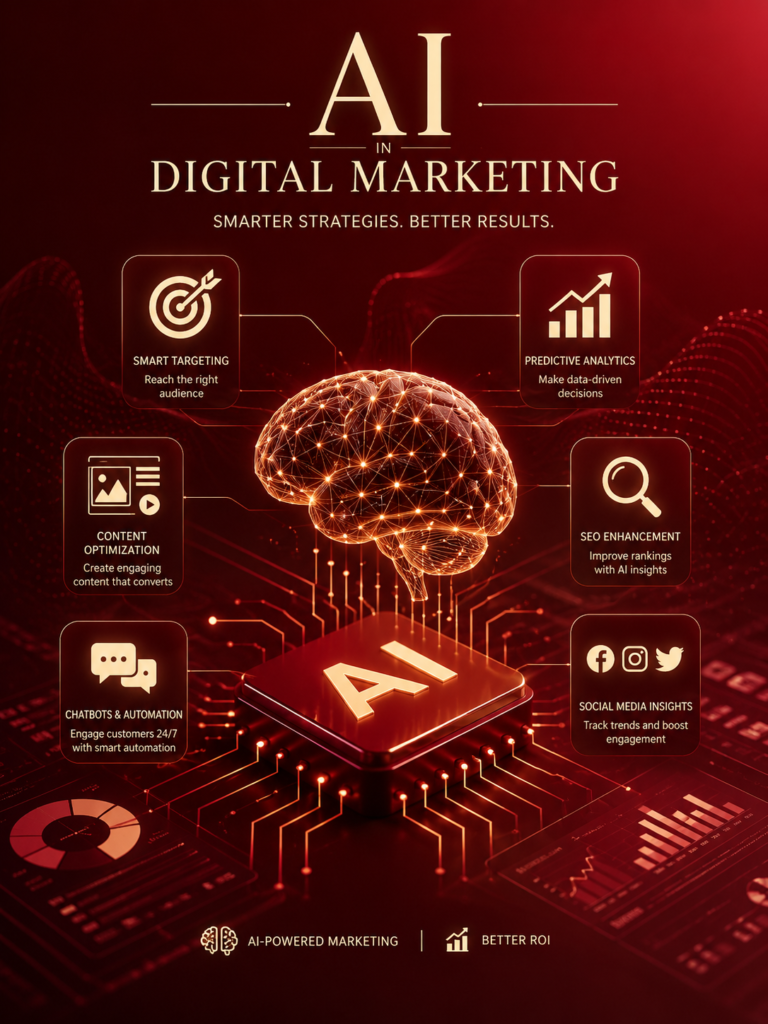
Artificial Intelligence (AI) has become one of the most powerful technologies shaping the future of digital marketing. From understanding customer behavior to creating personalized content, AI is helping businesses make smarter decisions, improve efficiency, and connect with their audiences in more meaningful ways. Digital marketing has traditionally depended on data, creativity, research, and continuous optimization, but AI is now bringing these elements together with greater speed and accuracy. As businesses compete for attention in an increasingly crowded digital environment, using AI effectively can help brands reach the right audience, deliver relevant experiences, and achieve better marketing results.
What Is AI in Digital Marketing?
AI in digital marketing refers to the use of artificial intelligence technologies to analyze information, understand customer behavior, automate marketing activities, and support decision-making. AI systems can process large amounts of data much faster than humans and identify patterns that may otherwise be difficult to recognize. This allows marketers to understand what customers are searching for, what type of content they prefer, when they are most active, and what factors influence their purchasing decisions. Instead of relying only on assumptions, marketers can use AI-powered insights to create more data-driven and effective strategies.
AI and Personalized Marketing
One of the biggest advantages of AI in digital marketing is personalization. Customers today expect brands to provide content and experiences that are relevant to their interests and needs. AI can analyze browsing behavior, purchase history, engagement patterns, and other marketing data to help businesses deliver more personalized messages. For example, an e-commerce brand can recommend products based on a customer’s previous interactions, while a digital marketing campaign can display different advertisements to different audience segments. This level of personalization can make customers feel better understood and can improve engagement, conversions, and long-term brand relationships.
AI in Content Creation
Content is at the heart of digital marketing, and AI is changing the way marketers plan, create, and optimize content. AI-powered tools can assist with generating ideas, creating outlines, writing drafts, analyzing keywords, developing social media captions, and identifying topics that may interest a target audience. However, AI should not replace human creativity and strategic thinking. The most effective approach is to use AI as a supporting tool while marketers provide originality, emotional understanding, brand personality, and human judgment. When technology and creativity work together, businesses can produce content more efficiently without losing the human connection that makes content valuable.
AI in Search Engine Optimization
Search Engine Optimization (SEO) is another area where AI is having a significant impact. AI can help marketers identify search trends, analyze keywords, understand search intent, study competitors, and discover content opportunities. It can also assist in analyzing website performance and identifying areas that may need improvement. Search engines themselves increasingly use AI to understand the meaning and context behind search queries and web content. Because of this, modern SEO is moving beyond simply adding keywords to a webpage. Marketers need to focus on creating useful, relevant, trustworthy, and user-focused content that genuinely answers what people are searching for.
AI in Social Media Marketing
Social media platforms generate enormous amounts of information every day, making it challenging for marketers to manually analyze every interaction. AI can help businesses monitor engagement, identify trends, understand audience sentiment, suggest content ideas, and optimize posting strategies. AI-powered systems can also help marketers identify which types of posts generate stronger engagement and which audience segments respond best to particular messages. This allows businesses to make social media strategies more efficient and data-driven while giving marketers more time to focus on creativity, community building, and brand communication.
AI-Powered Chatbots and Customer Service
AI-powered chatbots have become an important part of modern digital marketing and customer service. Chatbots can answer common questions, provide information, guide visitors through websites, and assist customers at any time of the day. This can improve the customer experience by providing quick responses without requiring a human representative to handle every basic inquiry. More advanced AI systems can understand natural language and provide increasingly personalized interactions. However, human support remains important for complex, sensitive, or highly personalized situations where empathy and judgment are required.
AI in Advertising and PPC Campaigns
AI is also transforming paid advertising, including Pay-Per-Click (PPC) campaigns. Digital advertising platforms can use machine learning to analyze audience behavior and optimize campaigns toward specific objectives such as clicks, leads, conversions, or sales. AI can help marketers identify high-performing audiences, adjust bids, test different creative variations, and allocate advertising budgets more effectively. Instead of manually analyzing every campaign element, marketers can use AI-driven insights to make faster decisions and continuously improve campaign performance. This can help businesses reduce wasted advertising spend while increasing the potential return on investment.
AI and Marketing Automation
Marketing automation becomes even more powerful when combined with AI. Businesses can automate repetitive activities such as email campaigns, customer segmentation, lead nurturing, reporting, and audience targeting. AI can help determine which customers should receive particular messages and when those messages are most likely to be effective. This saves marketers valuable time and allows them to concentrate on strategy, creativity, and relationship building. Automation also creates greater consistency, ensuring that customers receive timely communication throughout different stages of their journey.
Benefits of AI in Digital Marketing
The benefits of AI in digital marketing extend across almost every stage of a marketing campaign. AI can save time, improve productivity, analyze large amounts of data, support personalization, enhance customer experiences, and help marketers make more informed decisions. It can also help businesses identify trends faster and optimize campaigns continuously. For small businesses and individual marketers, AI can provide access to capabilities that previously required significant amounts of time, resources, or specialized expertise. When used strategically, AI can make digital marketing more efficient while helping businesses focus on achieving measurable results.
Challenges of Using AI in Digital Marketing
Although AI offers many advantages, businesses must also understand its limitations. AI-generated content can sometimes contain inaccurate, repetitive, or generic information, which means human review is essential. Privacy and responsible data usage are also important considerations because AI systems often depend on large amounts of customer information. Businesses must use customer data responsibly and maintain transparency when collecting and processing information. Another challenge is maintaining authenticity. If brands rely too heavily on automation, their communication can lose the human personality that customers value. The goal should therefore be to use AI responsibly while keeping human creativity, ethics, and judgment at the center of marketing.
The Future of AI in Digital Marketing
The future of AI in digital marketing is expected to become even more advanced as AI technologies continue to develop. Marketers will increasingly use AI to understand audiences, predict trends, automate workflows, personalize experiences, and optimize campaigns. At the same time, human skills such as creativity, strategic thinking, storytelling, emotional intelligence, and critical thinking will remain extremely important. The marketers who succeed in the future will not necessarily be those who use the most AI tools, but those who know how to combine AI capabilities with strong marketing fundamentals and a clear understanding of their audience.
Conclusion
AI is transforming digital marketing by making it faster, smarter, more personalized, and increasingly data-driven. From SEO and content creation to social media, advertising, customer service, predictive analytics, and automation, AI is becoming an important part of the modern marketer’s toolkit. However, technology alone cannot create a successful marketing strategy. The strongest results come when AI is combined with human creativity, strategic thinking, authentic communication, and responsible decision-making. As the digital landscape continues to evolve, businesses and marketers who learn to use AI effectively while maintaining a human-centered approach will be better positioned to build stronger brands, connect with their audiences, and achieve sustainable digital growth.