
Turn content into customers
Introduction
In digital marketing, creating content is only the beginning. The real challenge is turning that content into meaningful customer relationships and business growth. Every day, people interact with blog posts, social media content, videos, emails, guides, advertisements, and website pages before deciding whether they want to trust or purchase from a brand. This makes content one of the most powerful tools for attracting and influencing potential customers. A successful content marketing strategy does not focus only on getting views or likes; it focuses on providing the right information to the right audience at the right stage of their customer journey. When content is valuable, relevant, consistent, and strategically connected to business goals, it can transform visitors into leads and leads into loyal customers.
Understanding Your Audience
The first step in turning content into customers is understanding who you are creating content for. A business needs to know its target audience, their interests, challenges, goals, questions, and purchasing behavior. When marketers understand their audience, they can create content that speaks directly to real problems instead of producing generic information. For example, a digital marketing professional targeting small businesses could create content about improving Google visibility, generating leads through social media, or creating effective advertising campaigns. Such content is more likely to attract people who genuinely need those services.
Understanding the customer journey is equally important. Not every visitor is ready to make a purchase immediately. Some people are discovering a problem for the first time, while others are comparing solutions and looking for a service provider they can trust. Content should therefore support different stages of the journey, from awareness and consideration to conversion and retention.
Create Content That Provides Real Value
People do not become customers simply because a business publishes frequently. They become customers when they find content useful enough to trust the brand behind it. High-quality content should educate, solve problems, answer questions, inspire action, or provide a new perspective. Instead of creating content purely to promote a product or service, businesses should focus on helping their audience first.
Blog articles can answer common customer questions, videos can demonstrate solutions, case studies can show real results, and social media posts can provide quick insights. When these different formats work together, they create multiple opportunities for potential customers to interact with a brand. Valuable content can also establish authority and demonstrate that a business understands its industry and its customers.
Use Storytelling to Build Connection
Facts and information are important, but stories can make content more memorable. Storytelling allows brands to communicate their values, experiences, challenges, solutions, and results in a way that audiences can relate to. A strong brand story can help potential customers understand not only what a business offers, but also why it exists and how it can help them.
For example, instead of simply saying that a digital marketer provides SEO services, content could explain how a business struggled to attract organic traffic, what strategy was implemented, and how the business improved its online visibility. Stories create context and make the benefits of a service easier to understand. When audiences can see themselves in the problem and solution, they are more likely to take the next step.
Blog articles can answer common customer questions, videos can demonstrate solutions, case studies can show real results, and social media posts can provide quick insights. When these different formats work together, they create multiple opportunities for potential customers to interact with a brand. Valuable content can also establish authority and demonstrate that a business understands its industry and its customers.
Create Content for Every Stage of the Customer Journey
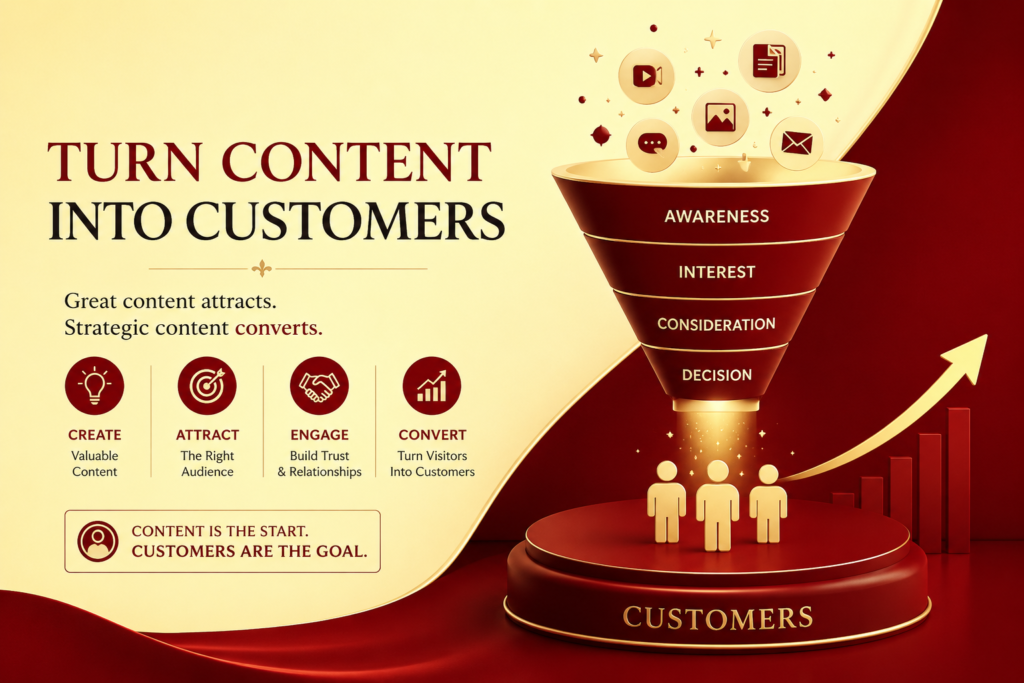
A strong content strategy should guide potential customers from discovery to decision. At the awareness stage, educational blogs, social media posts, short videos, and informative guides can introduce people to a problem or opportunity. At the consideration stage, detailed articles, comparison content, FAQs, webinars, and case studies can help people evaluate possible solutions. At the decision stage, testimonials, service pages, demonstrations, offers, and clear calls to action can encourage visitors to become customers.
This approach prevents businesses from expecting every piece of content to generate an immediate sale. Instead, each piece has a specific purpose. Some content attracts attention, some builds trust, and some encourages conversion. Together, they create a complete customer journey.
Add Strong Calls to Action
Even excellent content may fail to generate customers if visitors do not know what to do next. This is where a clear Call to Action (CTA) becomes important. A CTA tells the audience what action they can take after consuming the content. Depending on the stage of the customer journey, the action could be downloading a guide, subscribing to a newsletter, booking a consultation, requesting a quote, contacting the business, or purchasing a product.
Effective CTAs should be clear, relevant, and connected to the content. For example, a blog about SEO strategies could end with an invitation to request an SEO audit or consultation. Instead of leaving visitors at the end of an article, a CTA provides them with a natural next step toward becoming a potential customer.
This approach prevents businesses from expecting every piece of content to generate an immediate sale. Instead, each piece has a specific purpose. Some content attracts attention, some builds trust, and some encourages conversion. Together, they create a complete customer journey.
Build Trust Before Asking for the Sale
Trust is one of the most important factors in converting content consumers into customers. People want to know whether a business is credible, experienced, and capable of delivering what it promises. Content can help build this trust by demonstrating expertise and providing useful information consistently.
Testimonials, case studies, reviews, certifications, statistics, portfolio examples, and educational content can all strengthen credibility. Businesses should also avoid making unrealistic promises. Transparent and authentic communication helps create stronger relationships with audiences and can make potential customers more comfortable taking the next step.
Effective CTAs should be clear, relevant, and connected to the content. For example, a blog about SEO strategies could end with an invitation to request an SEO audit or consultation. Instead of leaving visitors at the end of an article, a CTA provides them with a natural next step toward becoming a potential customer.
This approach prevents businesses from expecting every piece of content to generate an immediate sale. Instead, each piece has a specific purpose. Some content attracts attention, some builds trust, and some encourages conversion. Together, they create a complete customer journey.
Use Multiple Content Channels
Customers consume content in different ways, so businesses should not depend on a single platform. A detailed blog post can be transformed into social media posts, short videos, email content, infographics, and other formats. This approach allows businesses to reach audiences across multiple channels while getting more value from the original content.
For example, one blog about SEO could become a LinkedIn post, an Instagram carousel, a short educational video, an email newsletter, and a website FAQ. Repurposing content can help maintain consistency while reaching people with different preferences for consuming information.
Optimize Content for Search Engines
Creating valuable content is important, but people need to be able to discover it. SEO helps content reach users who are actively searching for relevant information. Businesses can improve discoverability by researching relevant topics and search intent, creating descriptive titles, using logical headings, improving internal linking, and making pages easy for both users and search engines to understand.
However, SEO should support content quality rather than replace it. The objective should be to create useful content that satisfies the audience while following sound search-engine optimization practices. When valuable content and SEO work together, businesses can attract more relevant organic traffic and create additional opportunities for conversion.
Measure Content Performance
To understand whether content is actually turning visitors into customers, businesses need to measure performance. Traffic alone does not tell the complete story. Marketers should also look at metrics such as engagement, click-through rates, leads, email sign-ups, consultation requests, conversions, and revenue where appropriate.
Analyzing these results helps marketers identify which topics and formats are generating the strongest response. A blog post that receives fewer visitors but generates several qualified leads may be more valuable than a viral post that produces thousands of views without meaningful business results. The goal should therefore be to measure content according to its contribution to the overall customer journey and business objectives.
Conclusion
Turning content into customers requires more than simply publishing articles and social media posts. It requires a strategic approach that connects audience understanding, valuable information, storytelling, SEO, trust-building, strong calls to action, and performance measurement. Every piece of content should have a purpose and should help move the audience one step closer to taking meaningful action.
The most successful content strategies focus on people before promotion. When businesses consistently provide useful answers, solve real problems, demonstrate expertise, and guide audiences toward the right next step, content becomes more than marketing material—it becomes a powerful customer acquisition tool. Ultimately, the goal is not just to attract visitors but to create meaningful connections that turn attention into trust, trust into action, and action into long-term customer relationships.